Should you invest in new-build or existing properties in the mountains?
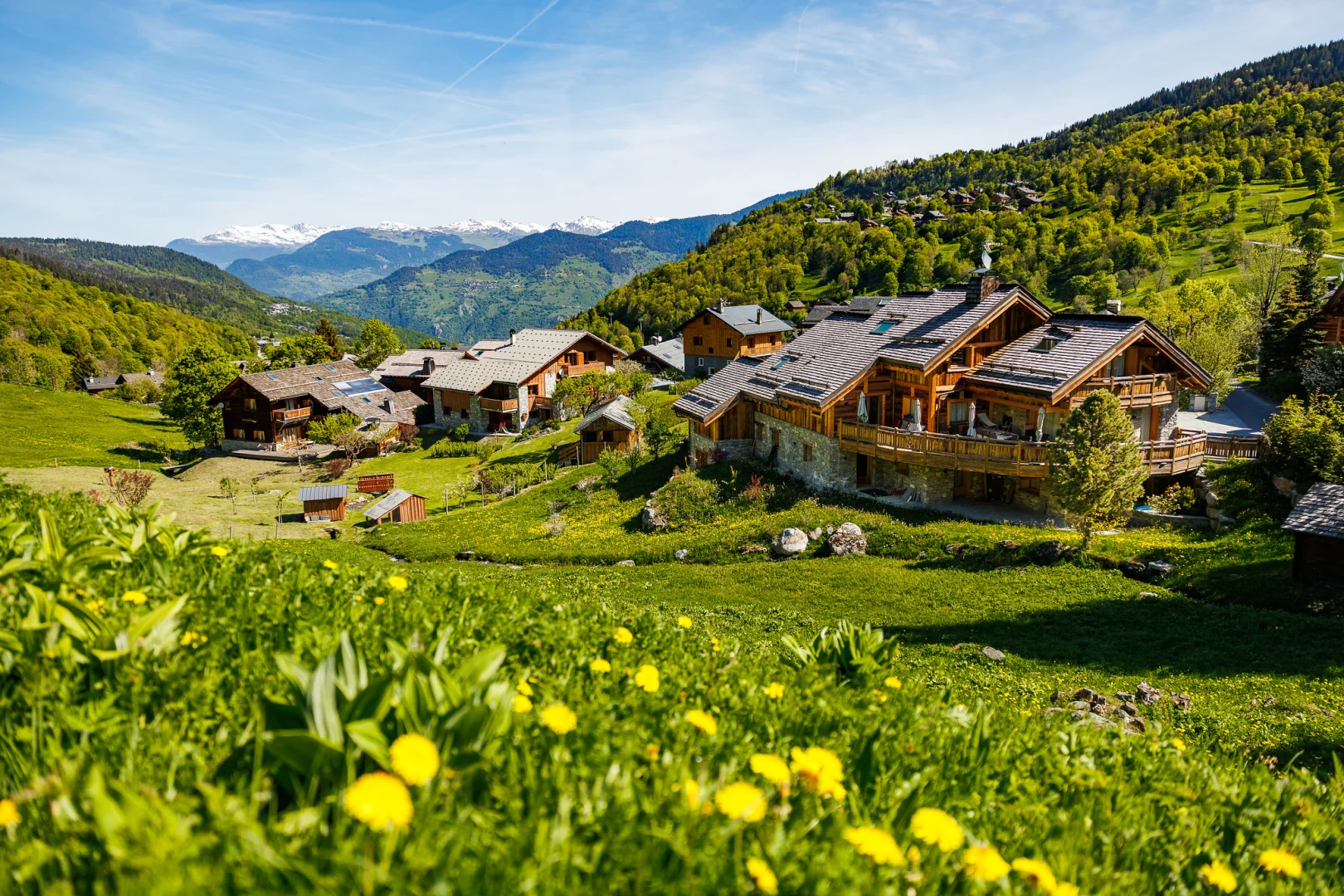
Investing in mountain property: should you choose a new-build or an older property?
- New-build properties offer automatic energy efficiency compliance, builder’s guarantees and reduced notary fees
- Existing properties appeal due to their prime locations, a lower price per square metre and potential for value appreciation following renovation
- The DPE 2034 regulations require strategic planning, whatever your investor profile
Looking for a specific property? Browse our selection: Buy a flat in Méribel.
Why buy a new-build in a mountain resort?
New-build properties at altitude combine builder’s guarantees, energy efficiency and tax benefits. It’s a sensible choice for investors who want to minimise unforeseen costs and comply with regulatory requirements without lifting a finger. But it’s still important to understand what this actually means in practice.
1. Builder’s guarantees tailored to mountain conditions
In the mountains, buildings are subjected to extreme weather conditions: freezing and thawing, heavy snow and sudden temperature changes. New-build properties protect you with three robust guarantees:
- The extended ten-year guarantee, which covers structures subject to these stresses for 10 years
- The guarantee of perfect completion, covering problems related to freeze-thaw cycles during the first year
- Compulsory building damage insurance, which covers claims specific to the mountain environment
2. Optimal energy performance for holiday rentals
A new property automatically complies with the RE2020 standard, placing it in energy performance classes A or B. For holiday rentals, this is a decisive advantage. From 2034, furnished holiday accommodation will have to have an energy performance rating between A and D to be let. Enhanced thermal insulation, state-of-the-art heating systems, triple glazing: the energy savings are substantial, especially as the cost per kWh rises with altitude. To understand these issues in detail, read our article on the Energy Performance Certificate (EPC) and holiday rentals in the mountains.
3. Tax benefits specific to new-build investments
From a financial perspective, new-build properties offer three concrete tax advantages:
- Notary fees of 2–3 per cent, compared with 8 per cent for existing properties, representing an immediate saving of several thousand euros
- The possibility of reclaiming VAT, subject to certain conditions, for furnished lettings in holiday accommodation
- An exemption from property tax for two years following completion of the works
Why opt for older properties when investing in a holiday resort?
Existing properties have advantages that new-builds can never replicate: location, charm and sometimes remarkable opportunities for negotiation. For investors prepared to factor in some renovation work, this is often the wisest choice. Find out why in our comprehensive guide: Investing in the Mountains.
1. Premium locations… right in the heart of the resorts!
New-build developments are being built on the outskirts. This makes sense: there’s no more land available at the foot of the slopes. Older properties, on the other hand, occupy the historic locations: direct access to the ski lifts, proximity to shops, and lively neighbourhoods. A traditional Savoyard chalet in the centre of Méribel, with its timber panelling and authentic charm, isn’t something you’ll find in a new-build development.
2. Potential for negotiation and value appreciation
The price per square metre for older properties remains 15 to 20 per cent lower than that of new-builds in the resort. There is also greater scope for negotiation, especially if the property requires work. And this is precisely where the opportunity lies: a well-executed energy-efficiency renovation can generate significant capital gains whilst bringing the property into line with future Energy Performance Certificate (EPC) requirements.
3. Tax optimisation if you opt for furnished lettings
Older properties offer powerful tax incentives, provided you make full use of them. The property loss is tax-deductible when you undertake renovation work. Under the LMNP or LMP schemes, you can write off the property’s value each year for accounting purposes. And if your furnished property is awarded a tourism classification, you’ll benefit from a flat-rate allowance of up to 50 per cent on your rental income. To find out more about these mechanisms, read our article on the tax implications of buying a property in the mountains.
And what about the new energy performance certificate (DPE) standards?
The law of 19 November 2024 extends energy performance certificate (EPC) requirements to furnished holiday lets. In practical terms, from 2034 onwards, any property rated E, F or G will be prohibited from being let on a short-term basis, unless it is the landlord’s main residence. This regulation fundamentally changes the situation.
For a new-build property, the issue doesn’t arise: compliance with RE2020 guarantees an A or B rating upon handover. No additional expenditure is required.
For older properties, the issue is more complex. The average cost of an energy-efficiency refurbishment in a resort ranges from €30,000 to €60,000, depending on the condition of the building and its floor area. This is a substantial outlay. But it is also an opportunity: older properties with poor energy ratings are seeing their prices fall, creating attractive buying opportunities for investors able to finance the work.
Which investment strategy should I prioritise depending on my plans?
The right choice depends on your main objective.
Here’s a summary to help you see things more clearly:
|
Criterion |
Intensive holiday let |
Second home with occasional letting |
|
Recommended type of property |
New-build (compliant with energy performance certificate requirements) or older property in a good location |
Existing (charm, location) or new-build (comfort) |
|
Top priority |
Rental yield and compliance |
Enjoyment of use and flexibility |
|
Energy Performance Certificate |
Essential (A to D) |
Exemption possible if used as a main residence |
|
Key tax considerations |
Furnished holiday let classification |
LMNP with depreciation |
For intensive short-term lettings
If you’re aiming for maximum rental profitability, a new-build avoids the need for renovation work and guarantees compliance with energy performance regulations at no extra cost. An older property in a prime location (at the foot of the slopes, in the resort centre) may generate a higher immediate return, but you’ll need to budget for bringing it up to standard. In both cases, tourist accommodation classification remains essential to qualify for the tax allowance.
For a second home with occasional letting
Do you want to enjoy your property and let it out for a few weeks a year? Older properties offer the charm and prime locations that make all the difference in day-to-day life. New-builds provide modern comfort and require no maintenance in the early years. If you register the property as your main residence, you are exempt from energy performance certificate (DPE) requirements when letting it out.
What hidden costs should you expect in each case?
The purchase price represents only part of the actual budget. Here’s what many investors discover too late.
For new-builds: allow for connection charges to utilities, interior fitting-out (a property delivered in a ‘shell’ state will require a fitted kitchen, furniture and appliances) and any external works.
For older properties: a technical survey is essential: bringing electrical installations up to standard, façade refurbishment, and replacement of windows and doors. Allow between €800 and €1,500 for a professional energy audit; this is a necessary step before committing to any purchase.
In both cases, service charges for flat ownership in the mountains are higher than in the lowlands: snow clearance, maintenance of the communal boiler room and upkeep of access routes. And if you entrust the rental management to a professional, allow for between 18 and 25 per cent of the rental income to cover management fees.
So, how do you finance the purchase of a property in a ski resort?
Banks apply specific criteria for financing in tourist areas: a minimum deposit of 20 to 30 per cent, compared with 10 per cent in standard urban areas. The requirements are stricter.
The good news is that the interest-free loan (PTZ) remains available for second-hand properties if the renovation work accounts for at least 25 per cent of the total cost of the transaction. For investors, an interest-only loan is particularly suitable: you only pay the interest during the term of the loan, which improves your monthly cash flow.
A practical tip: draw up a solid rental business plan before meeting your bank manager. Include projected occupancy rates, estimated rental income and anticipated service charges. It is this document that will make the difference between a refusal and approval.
FAQ: everything you need to know about investing in new-build versus second-hand properties in the mountains
Is it more profitable to buy a new-build or an older studio flat in the 3 Vallées?
An older property in a good location generally offers a higher gross return thanks to a lower purchase price. A new-build compensates for this with lower service charges and no need for renovation work in the first few years.
Can you still let a flat with an F energy rating in the 3 Vallées?
Yes, until 2034. After that date, furnished holiday accommodation classified as E, F or G will be banned from seasonal letting, unless it is the landlord’s main residence.
How much are the notary fees?
Allow for 2 to 3 per cent of the price for new-build properties and around 8 per cent for older properties. For a property worth €400,000, the difference amounts to €20,000 to €24,000.
