Looking to buy a house, flat or chalet in a ski resort?
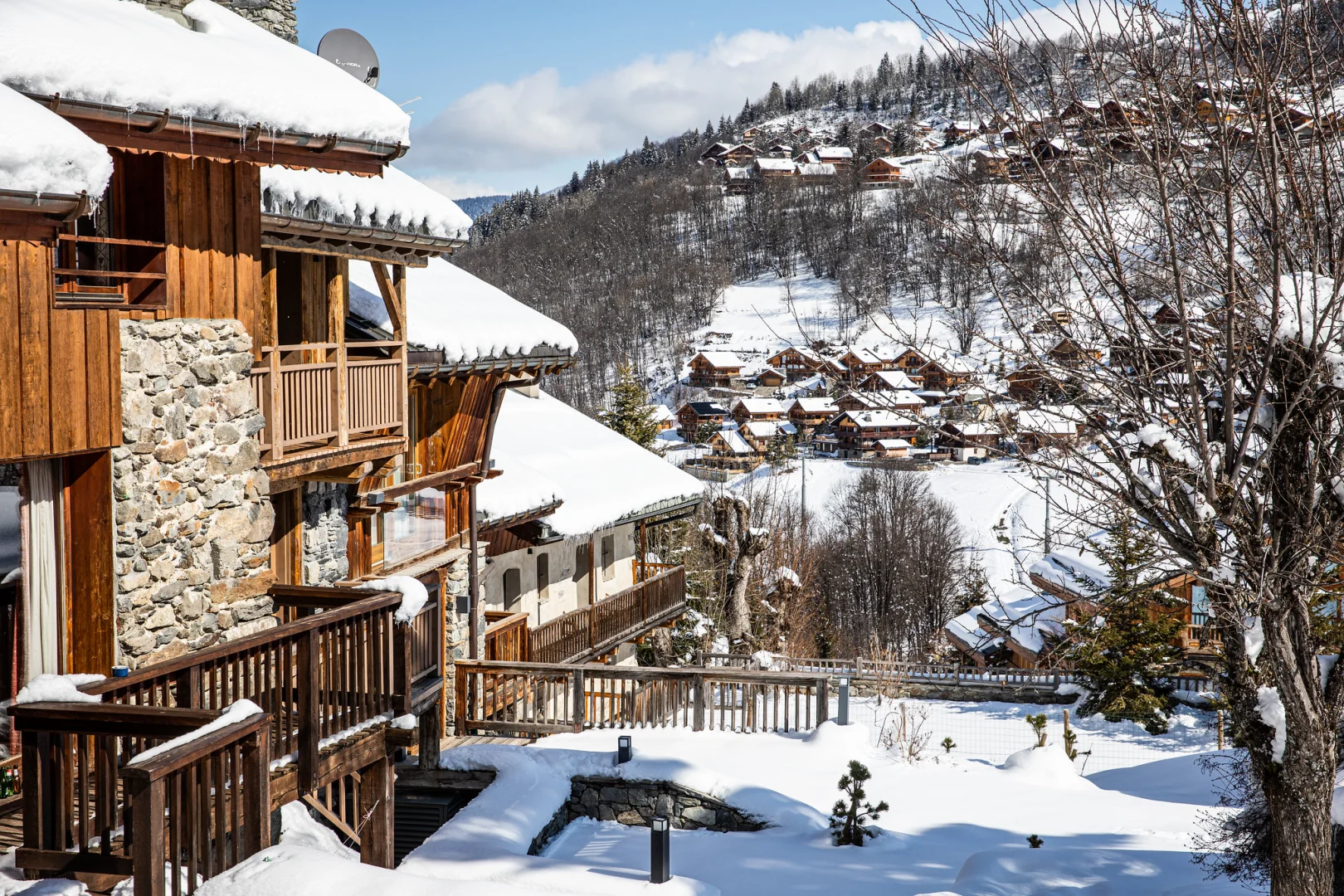
Three points to bear in mind before going any further:
- The chalet charms with its authenticity, but requires regular maintenance of the timber and a substantial budget
- The house offers ideal flexibility for a year-round home, with spaces that can be adapted as the family grows
- An apartment in the resort remains the most practical choice for a profitable rental investment with simplified management
Already looking for specific properties? Browse our catalogue for apartments for sale in Méribel.
Chalet or house: what are the architectural and material differences in the mountains?
Chalets and houses differ primarily in their building materials and how they cope with the mountain climate. Solid timber naturally regulates humidity and insulates around 15 per cent better than concrete, whilst stone offers thermal inertia and durability that are hard to match. These structural choices influence the interior ambience, maintenance costs and how well the building blends into the alpine landscape.
Solid timber versus traditional masonry
Wood possesses natural hygroscopic properties: it absorbs and releases ambient humidity without causing condensation. As a result, the indoor air in a chalet remains healthy all year round, without the need for forced mechanical ventilation.
Stone and concrete offer a different approach. Their high thermal inertia stores heat during the day and releases it at night. However, these materials require additional insulation to meet current standards.
As for ambience, it’s a matter of taste! Wood creates a warm, almost cosy atmosphere. Masonry offers architectural neutrality that lends itself to all styles of interior design.
Roof design and adaptation to the mountain climate
In the mountains, the roof is not merely an aesthetic detail. It is a matter of safety. Traditional chalets feature steeply pitched roofs (at least 45° in the Alps) to allow snow to slide off before it reaches critical loads.
Wide eaves protect the façades from the elements, including driving rain and frost. This time-honoured design remains relevant, even for new builds.
A chalet blends naturally into a wooded, high-altitude landscape. A house, on the other hand, fits more easily into the built-up areas of a resort, where local planning regulations sometimes impose strict architectural constraints.
Is a chalet really a ‘must-have’ in the mountains?
A chalet offers a sensory experience that no other type of property can replicate. The scent of resin, the hushed silence of the timber, the spacious interiors beneath exposed beams: it is as much a way of life as it is a home. For those seeking a complete change of scenery after a day’s skiing, the answer is a resounding yes. But let’s be honest: it’s not the only right answer, and depending on the nature of your stay, a flat might even prove to be the smarter choice.
In practical terms, what makes the chalet so special?
The sound-absorbing properties of the wood create a rare sense of calm. You can’t hear the wind or the neighbours. The large floor-to-ceiling windows blur the boundary between the interior and the snow-covered landscape.
And then there’s the interior design. The cathedral-style living room, with its impressive ceiling height and central fireplace, turns every evening into a shared experience. The open-plan layout encourages socialising. You cook, chat and spend time together without getting in each other’s way.
It’s the ideal setting for hosting family and friends. Let’s be honest: a chalet is best enjoyed with others. For a short stay or on a tighter budget, a well-located flat will often do just as well
A second home as a holiday residence
The traditional holiday home in a resort is ideal for those who prioritise flexible layouts and proximity to everyday amenities. Its non-load-bearing walls allow for alterations over the years, and its suburban location reduces logistical constraints, especially for families planning a longer stay.
But then, why do some buyers prefer a house to a chalet?
Firstly, flexibility. Expecting a third child? Want to add a study or a utility room? Partitions can be moved easily without affecting the structure. The clear separation between day and night areas also guarantees a level of privacy that an open-plan chalet does not always offer.
Secondly, location works in the house’s favour. In the outskirts of a resort town, you can access shops, schools and medical services without taking the car. Transport links are nearby. Journey times remain short.
For families who live in the mountains all year round (or who are considering making it their main residence one day), a house remains the most sensible choice.
The resort flat: the alternative you need in 2026?
A holiday apartment in a resort combines affordability, everyday convenience and high rental potential. In fact, this is the type of property we most often offer at Saulire Estate Agents, and for good reason: it ticks all the boxes that matter to the majority of buyers in the mountains.
The first advantage – and by no means the least – is its immediate proximity to the slopes. In Méribel Mottaret, most residential complexes offer ski-in/ski-out access. You put your skis on in the lobby, and you’re on the snow thirty seconds later. It’s hard to beat that.
The services provided by the owners’ association make everything easier. Snow clearance, maintenance of communal areas, security: the property manager takes care of it all. You simply get to enjoy it.
In terms of budget, the initial outlay remains more affordable than a chalet. Service charges are shared amongst co-owners, which reduces the individual outlay on maintenance. And if you don’t occupy the property for the whole season, seasonal lettings with a management agency generate income without you having to lift a finger.
Still not sure? Read our full analysis to find out whether buying a ski apartment is still a good idea in 2026.
A decision to be made based on maintenance and technical ‘challenges’…
The specific maintenance requirements of wooden chalets
A wooden chalet is beautiful. But it comes at a price. In a mountain environment, wood is exposed to UV rays, frost, damp and wood-boring insects.
You’ll need to apply a coat of wood stain roughly every five years, plus regular antifungal treatments. In terms of both time and money, this is a recurring expense that shouldn’t be underestimated. Constant vigilance is required to preserve the structure in the long term.
Be mindful of energy performance depending on the type of construction!
Old chalets often suffer from significant thermal bridges at the timber joints. The airtightness of older structures also leaves much to be desired.
Stone, on the other hand, offers superior thermal inertia: heat is stored and released slowly. Wood heats up quickly, but cools down just as quickly.
To renovate an old chalet without compromising its character, external insulation remains the best solution. It preserves the exposed timber interior walls whilst addressing heat loss.
The advantage of a flat: minimal maintenance + shared service charges
In a block of flats, the maintenance of communal areas is managed by the property manager. Roof, façade, green spaces: that’s not your problem.
Maintenance costs are shared. Your maintenance budget becomes predictable thanks to quarterly service charge calls. No nasty surprises, no hefty bills after a harsh winter.
So, which option offers the best return?
Resale value & rental potential
The luxury chalet market is a niche market that is more volatile than the flat market. Prices can soar or plummet depending on market conditions and the exact location.
For holiday lets, chalets remain in high demand (with high weekly rates). However, flats in residential complexes are easier to let, with rental management simplified by on-site professionals.
It’s also worth noting that banks can sometimes be cautious about properties built entirely of timber. Securing finance for a flat or a stone-built house is generally easier to arrange.
To find out more about profitability, see our guide to self-financing your rental property in the mountains.
Environmental impact: timber, concrete or a block of flats?
Wood stores CO₂ throughout its entire lifespan. It is the most carbon-friendly building material.
Concrete, on the other hand, generates a very high level of embodied energy during its manufacture. Block-of-flats living partially offsets this drawback through shared energy systems (central heating, building-wide insulation).
Regardless of the material, a property built to the correct standards can last for over a century. The quality of construction takes precedence over the choice of raw material.
So, how do you choose between a chalet, a house or a flat depending on your plans?
The right choice depends on your lifestyle, your budget and how often you plan to use the property. There is no one-size-fits-all answer, but rather a personal balance between authenticity, practicality and cost-effectiveness. Here is our verdict, summarised in this table.
|
Criterion |
Chalet |
House |
Flat |
|
Purchase budget |
High |
Medium to high |
More affordable |
|
Annual maintenance |
Demanding (wood stain, treatments) |
Moderate |
Minimal (shared service charges) |
|
Rental potential |
High (high rates) |
Medium |
Strong (outsourced management) |
|
Year-round living |
Possible but restrictive |
Ideal |
Suitable |
|
Atmosphere |
Authentic, welcoming |
Neutral, adaptable |
Functional |
|
Carbon footprint |
Low (wood) |
High (concrete/stone) |
Medium (shared) |
- Choose the chalet if you’re looking for authentic Alpine charm, a complete change of scenery, and aren’t put off by regular maintenance
- Opt for the house if you’re considering a year-round home with flexible living spaces, close to amenities
- Choose the flat if your priority is a rental investment, the convenience of ski-in/ski-out access and a controlled budget
A word of advice before you sign: view several different types of property. What you imagine at the outset doesn’t always match how it feels when you’re there. And make sure you’re supported by professionals who know the local market. With over 40 years’ experience in the 3 Vallées, our team in Méribel and Courchevel La Tania can guide you towards the property that truly suits your plans.
FAQ: choosing between a house, flat or chalet when buying a property in a ski resort
What type of property rents out best in a ski resort?
Flats dominate the seasonal rental market in ski resorts thanks to their proximity to the slopes and the ease of managing them. To find out about price trends, visit our page on property prices in ski resorts.
How much does annual maintenance cost for a chalet compared to a house?
Expect to pay between €2,000 and €5,000 a year for a chalet (wood stain, treatments, minor woodwork). A brick-built house generally costs between €1,000 and €2,500 a year, excluding major works.
What is the lifespan of a wooden chalet in the mountains?
A well-maintained chalet will last over 100 years without any problems. The key is to follow the wood treatment cycles and check the joints after each winter season.
